Crypto Mixers 2026: reclaim your on-chain privacy.
Every satoshi you send leaves a trail. Crypto mixers break that trail. We compare the top tumblers of 2026, unpack how modern blenders work under the hood, and help you pick the service that fits how you actually move value.
What is a crypto mixer?
A crypto mixer — is a service that pools incoming deposits from many users and releases equivalent, unrelated coins from separate reserves. The link between your deposit address and the outputs you receive gets severed at the pool layer. The result is easy to describe and hard to trace: fresh coins, no direct chain link, no cluster analysis pointing back to you.
Btc tumblers were originally a workaround for a design decision Bitcoin never intended to hide. Public ledgers make every transaction searchable forever. A modern crypto blender is the counterweight — it lets you use a transparent chain without publishing your full financial history to anyone with a block explorer.
How crypto mixers actually work
Centralized tumblers
Centralized crypto tumblers hold a large float of pre-mined and rotated coins. When you deposit, the service tags your intended output amount and pays you from a reserve you never touched. Your deposit sits in the pool, aging until it is mixed into future payouts. Speed is the advantage; trust in the operator is the trade-off.
Decentralized blenders
Decentralized crypto blenders use cryptographic commitments — CoinJoin variants, zero-knowledge proofs, or ring signatures — so the mixing happens on-chain but nobody, not even the coordinator, can map inputs to outputs. Slower, more technical, and structurally resistant to logging.
Latency, pool depth and output distribution matter more than raw fee. A cheap mixer with a shallow pool leaks statistical fingerprints. A well-funded blender with randomized delays, split outputs and variable amounts is the one that actually holds up to modern chain analysis.
Top crypto mixers of 2026, compared
Ranked on pool depth, no-logs architecture, output flexibility and observed uptime. Fees shown are the minimum service fee — total cost depends on the randomized fee your selected mixer applies.
| Service | Type | Coins | Min fee | Delay | No-logs | Onion |
|---|---|---|---|---|---|---|
| Whir | Centralized | BTC · LTC | 0.4% | 0–24h | Yes | ✔ |
| Coinomize | Centralized | BTC | 0.5% | 1–96h | Yes | ✔ |
| Mixero | Centralized | BTC · ETH | 0.5% | 0–72h | Yes | ✔ |
| Sinbad-style CoinJoin | Decentralized | BTC | 0.3% | rounds | Structural | ✔ |
| Anonymixer | Centralized | BTC · LTC · ETH | 0.6% | 0–48h | Yes | ✔ |
Data reviewed February–July 2026. Verify current terms on each service before depositing; small operational changes happen quarterly.
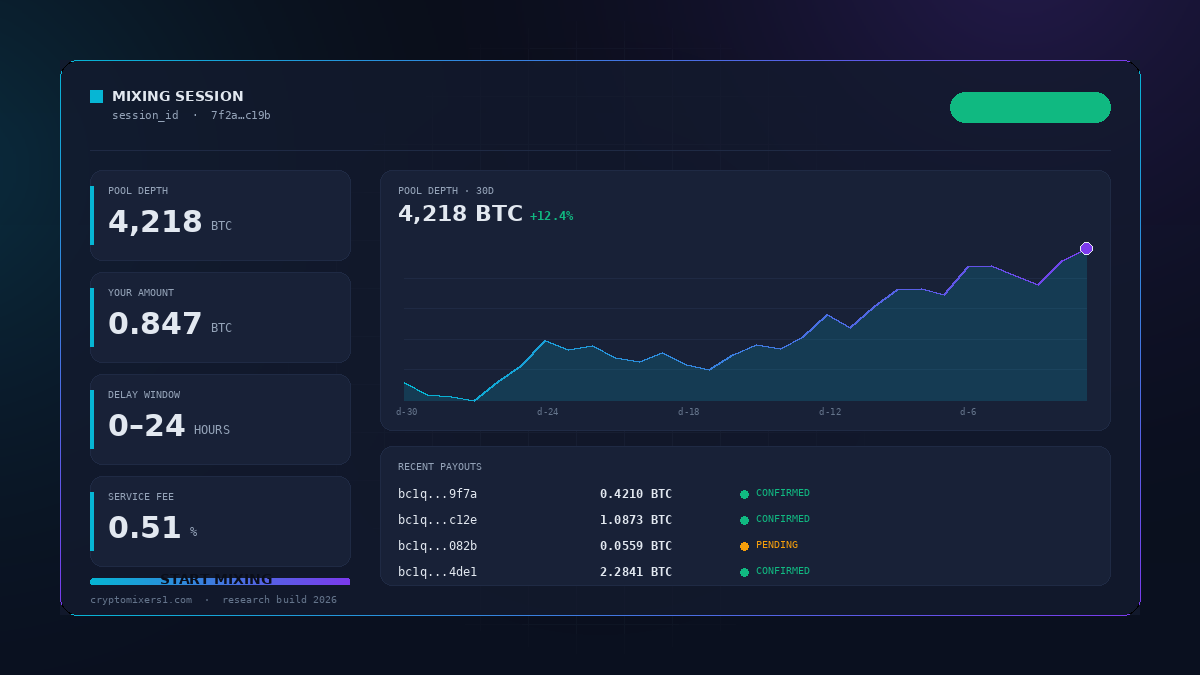
How to mix your crypto — step by step
This is the workflow experienced users follow when running funds through a crypto tumbler in 2026. Read all ten steps before you start.
Pick a mixer that fits your threat model
Match the service to what you are actually defending against. Deep pool, supported coin, and jurisdictional posture matter more than a slick landing page.
Open the service over Tor
Always access crypto mixers through the onion mirror or an equally hardened channel. Never over a residential IP tied to your identity.
Enter your destination address
If the mixer supports multiple output addresses with percentage splits, use them. Single-address payouts are easier to correlate.
Choose a randomized delay window
A 2 to 24 hour window is a strong default. Zero-delay payouts undermine the whole point of using a blender.
Set the fee inside the recommended range
Extreme low and extreme high fees both stand out. Random-within-range is what modern crypto mixers use to blend fee fingerprints.
Save the mixing code and letter of guarantee
This is your proof if support ever needs to reissue. Store it encrypted; delete after payout confirms.
Send the deposit in a single transaction
Multiple small deposits create a distinct pattern. One clean transaction from the source address is cleaner.
Wait — do not refresh or chase confirmations
The delay is the feature. Watching a block explorer during the mix creates timing signals if your session is ever profiled.
Verify the payout arrived correctly
Check the amount landed in the intended address before closing the mixing window.
Discard the deposit address and code
Rotate to fresh addresses next round. Reusing anything from a completed mix defeats the anonymity you just paid for.
Who actually uses crypto mixers?
Not everyone using a tumbler is trying to hide something illegal. Traders don't want competitors mapping their positions from on-chain flows. Journalists working in hostile jurisdictions need to receive tips without doxxing sources. Merchants who accept coins don't want customer addresses linked back to their business float. Long-term holders scrub coins before moving to cold storage, so a future hack of a hot wallet can't be traced upstream to the vault. On-chain privacy is a normal operational concern in 2026 — not a confession.
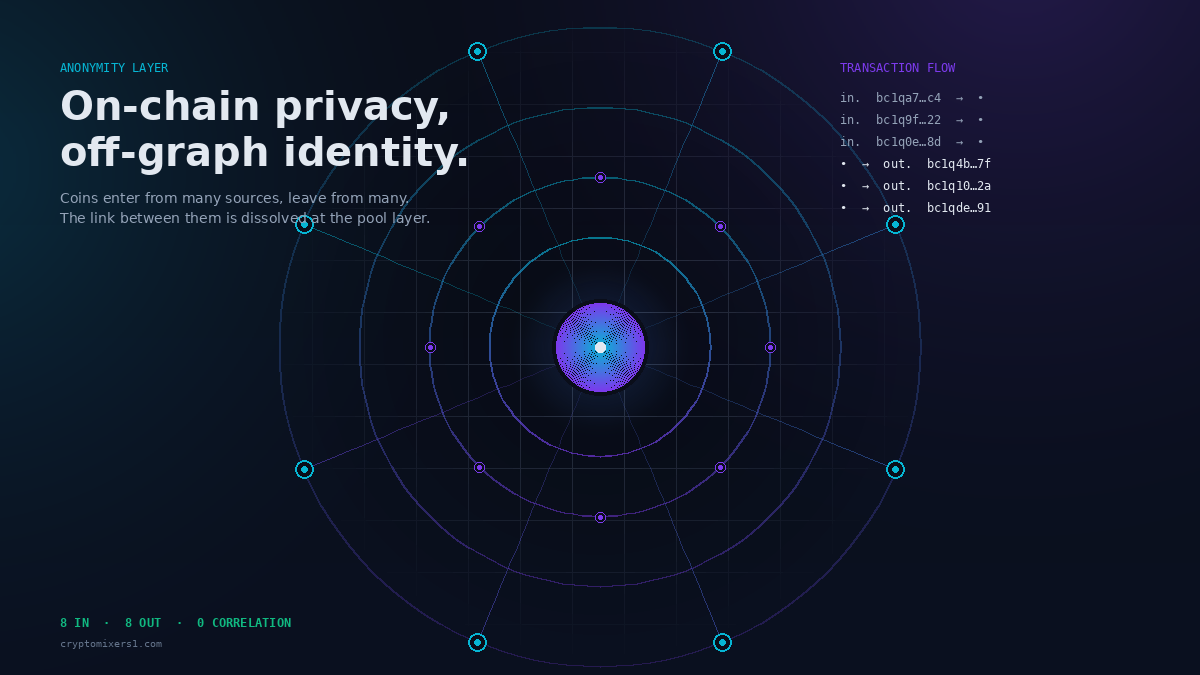
What separates a serious crypto blender from a scam
- Public no-logs policy backed by architecture that makes logging structurally hard
- Onion mirror available and PGP-signed
- Letter of guarantee — cryptographic proof the address belonged to the service
- Randomized fee within a range, not a fixed percentage
- Multi-address output with variable split percentages
- Pool audit or on-chain reserve disclosure
- No KYC, no email required, no fingerprintable checkout flow
- Uptime history longer than 12 months on the current infrastructure
Expert opinion
“The crypto mixers that survive 2026 aren't the flashiest — they're the ones with deep pools and boring uptime. Chain analysis firms don't beat mixers by breaking cryptography; they beat them by finding statistical patterns in tiny reserves and predictable delays. Pick a blender that looks statistically indistinguishable from noise, and you're already ahead of ninety percent of users.”
Frequently asked questions
Are crypto mixers legal?
Legality depends on your jurisdiction and how you use the service. In most places, using a mixer to protect personal financial privacy is not itself a crime — but sanctions and specific enforcement actions have targeted certain services. Check your local rules before depositing.
How long does mixing actually take?
Anywhere from a few minutes to more than 24 hours depending on the delay you select. Longer delays give stronger anonymity because they de-correlate your deposit and payout from timing analysis.
What is the difference between a mixer, a tumbler and a blender?
They mean the same thing. Mixer and tumbler are the older terms; blender caught on more recently. All three describe a service that severs the link between input and output coins.
Can a crypto mixer steal my funds?
Any custodial service can, in theory. That is why the letter of guarantee and multi-year reputation matter. Test with a small amount before committing anything meaningful.
Do modern chain analysis tools break mixers?
They erode weak ones. A mixer with a small pool, fixed fees and predictable timing leaks. A mixer with deep reserves, randomized parameters and no logs is still functionally opaque to public tools in 2026.
Which crypto mixer is best in 2026?
There isn't one universal answer. Match the service to your threat model — a whistleblower has different needs than a trader rotating profit into cold storage.